

If CES 2025 was about the promise of AI, this year’s CES2026 is all about its purpose. AI agents, humanoid robots, and a flood of smart glasses dominated the floor, each trying to prove their real-world value. While in 2025, the AI word itself was on all boards, posters, attached to solutions/company names, this year we a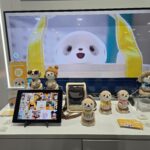 re nevertheless seeing a different approach from AI agents, who arehighlightingthe more ‘applicative’ usages, rather than just hype. AI is being integrated into pretty much anything though, some more successfully, others less. We can see for example an explosion of AI-driven dolls and furs, and I witnessed an AI penguin, AI dog, AI panda, AI cat, AI lemur or AI Japanese Kumamon (created by a Chinese brand though!). All these “kawaii” characters aimed at becoming your friend (pet?) that you have always been dreaming of, for adults and children alike. I’ll let you mentally process what it means for our future!!!
Humanoid Robots: Technical promise vs. real-world readiness
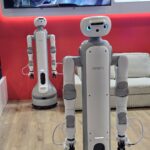 The other noticeable phenomenon in the CES2026 alleyways, are the great number of humanoid robots. The promises lie in the fact that in a (very) near future, as well as playing music, they will clean your house, provide back massages, or help our elderly. The demonstrations for most are showing the dexterity and the precision of the robot’s movements, which can be sometimes really impressive. I am particularly impressed by a demonstration of a tiny robot wearing a Lion costume (Chinese New Year outfit type), after having watched for a few moments, I suddenly realised that it was not a human underneath!
Smart Glasses: An exploding market in search of clarity
Regarding my main professional centre of interest, smartglasses, they are undoubtedly the other star of the show. They are everywhere, from the first slide of the CES2026 global opening presentation, to the mouth or presentation of most of the consumer electronics companies (TCL, Lenovo, Hisense…). Across the whole exhibition, the challenge is to understand where the products sit, between the ready to launch product, the “must-have” prototype linked to no market plan, and the reference design that is just a platform for customers to build their own glasses.
As no serious consumer electronic brand can’t have their own “AI glasses”, a race has started to develop “the product” that will follow in Rayban Meta’s footsteps. Whether it be with or without display, there are few product specification differentiations though, and usages remain relatively the same. That said, we can still spot the manufacturers’ various choices such as not having a camera focusing on weight or no speakers (Xgimi). Even Realities are presenting their G2 model, with a centred, more qualitative monochrome green screen. They still preserve the form factor (no camera) and are probably one of the very few coming from the eyewear business before entering the AI glasses market. This explains their successful sales, as they understand the corridors of the optical industry. Even Rokid, an historic player in the domain of “AR smartglasses”, released their AI glasses with display (monochrome green), alongside a pair of AI glasses…without display!
In terms of marketing, the direction taken by most is to focus on known usages, with several “translation glasses”, referring to the most advertised usage of AI glasses (Leion Hey 2 for example), focusing on the disabled population (Seehaptics) or even focusing on a specific usage as Cancer Free Biotech using the glasses for compliance checks in the medical industry. But overall, it is clear that usages REALLY need to be developed further to seduce the mass population. A war is definitely on, and the end-user may have a challenging time figuring out the difference…. except from the proposed AI that could make the difference for a user conscious of where his data is going and is being used.
A surprising announcement comes from Siemens at their keynotes at CES2026. Besides the numerous partnerships announced (Qualcomm, Nvidia, PepsiCo…), they report their new partnership with Meta, to use a version of Rayban Meta on the shopfloor for technicians is using AI+camera capabilities. This is very unexpected as Meta’s strategy is focused on data collection. This has been historically challenged by the industry because of their closed system on VR headsets and in the case of AI glasses, it means using Meta AI as well. Moreover the “glasses” form factor on the shopfloor has its challenges, not to mention them being fragile and not rugged enough, the management of prescription glasses (for more than 65% of the population, probably higher in factories because of the age average of the workers), the fact that this same prescription is GDPR covered in Europe. This implies that a user can refuse to share a piece of information. It also means managing installed base of products that cannot be shared among individuals. Either Meta will develop a very different product for Siemens, or this announcement may not go very far…. Topic to be thoroughly followed! I’m keeping a close eye on this one.
In the category of so called “AR glasses”, I can witness an interesting evolution at CES2026 with the arrival of 2 new products at RayNeo: RayNeo Air 4 Pro, a tethered product to your console, phone or PC, with a very good field or view and image quality. It is simply a secondary display at a very attractive price ($299, end of January). RayNeo X3 pro on the other hand is probably one of the most advanced binocular full colour glasses keeping the eyewear form factor with SLAM and 6DoF capabilities. This is a great breakthrough, even if the battery life may be a bit poor (and the product pricy at $1 099), they are clearly leading the way to eventually replace our 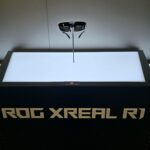 smartphones (with an upcoming version integrating an e-sim!). On its side XREAL is pushing the boundaries of the specifications, capabilities and usage, with a more affordable model with 1S, a demo of their future gesture control, and their new 240hz model for gamers, co-developed and co-designed with Republic of Gamers (ROG). They unveil very little information on project Aura, meant to be released in 2026. Gaming remains a key use case for binocular full colour displays with large FOVs. The other well-known brand present at CES, INMO, introduces Air 3, recently released after a successful Kickstarter campaign. It is the entertainment product of the brand, with 1080p full colour display, while GO3 is more an AI glasses with display (monocolour green) that will be released in May 2026 at $599.
Regarding industrial products, there’s nothing new on the AR side, but as well as their OEM optical portfolio, Vuzix presented anew 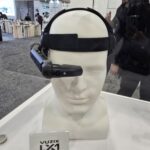 LX1 monocular model which is being released later this month. I also met Sebastian Beetschen from RealWear who was presenting the ARC3 their most recently released model. This shows the very good business managed around these models for remote assistance notably, probably the most cost-efficient solution on the industrial market, but still not deployed enough in my opinion!
Underlying Innovations: Components and UX
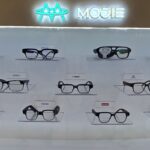
There are, in parallel, quite a few component providers from the “optics” side such as Mojie (with a reference design with display weighing only 25gr!), the Canadian VueReal, or the Japanese Cellid. We can see proposals as well for eyetracking such as Eyechip, with a hardware-based eyetracking solution, or organisations like Ledenjar, offering efficient patented solution to dramatically improve the battery life of wearables. These types of companies show the traction of the smartglasses market now that the sales numbers are higher than ever.
The evolution of UX/UI in wearable is interesting too at CES2026. Solutions like the MudraBand, with its intuitive gesture control, and Double Point’s precision input methods showcased how far we’ve come in making technology more natural and accessible. Sensoryx stands out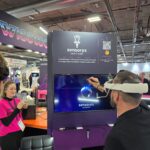 as a game-changer, especially with its multimodal approach: integrating a pen, ring, and pointer alongside their patented 6DoF ultrasound solution, which try to redefine how we interact with AR/VR environments. Overall, however we need additional UX/UI innovations that would align more with the focus on practical, user-centric solutions and especially for AI/AR glasses. It can be maybe found around BCI offers, with companies like Naqi Logix, who are developing neural wearables that let users control devices through subtle facial micro gestures or Neuranics, pioneering human machine interaction with ultra-sensitive TMR sensors, custom circuits and AI. This is, nonetheless, in its early stages, and technical precision as well as users’ acceptability need to be worked on.
Multisensory gaps
In the field of haptics, olfactive, and other sensory tools, it is rather deceptive; although VR headsets were heavily deployed in 2025 for training purposes, there are very few solutions at CES to enhance the experiences (not only for training but potentially for cultural experiences in Location Based Entertainment (LBE) as well. In addition, I have seen how multi-sensory AR – combining visuals with touch or scent – can transform visitor/trainee’s participation. I cannot get hold of Quester or Digital Scent, but I eventually met the Italian Weart presenting an updated version of their haptic gloves TouchDiver Pro on TDK booth (with some nicely improved cold and hot features).
Looking Ahead
CES2026 is all about glasses, and there is a strong interest from all visitors (referring to the huge queues at AI and AR glasses stands) So what can we expect from now on? The explosion of connected glasses at CES 2026 is telling: manufacturers are chasing ‘safe’ use cases where demand is obvious. But as my work in deploying AR solutions shows, the real breakthroughs come when technology solves a pain point so well that users can’t ever imagine going back- like technicians fixing equipment with real-time expert guidance. Consumer glasses absolutely need their own ‘killer app’. This should all come along with AI management clarity, data privacy and standardization to overcome the users’ concerns. Hopefully we will see at CES2027 more new well-thought-out usages rather than new specification-driven glasses.